The traditional stone house of the Dalmatian hinterland is a thoughtful whole created by centuries of experience living in the karst. Each of its elements – from the wall to the chimney – has a clear justification: functional, climatic and social. It is these architectural elements that create the recognizable identity of the house and the space to which it belongs.
Architecture and development of forms
In the distant past, homes were extremely modest – often just one-room houses with a hearth in the center, where people and livestock sometimes lived under the same roof, separated only by a light partition. Development led to multi-room houses that expanded horizontally and vertically:
- Tower (storey building): A floor used for sleeping is added to the ground floor, while on the ground floor there are taverns (in wine-growing regions) or stables (in livestock regions).
- Kužina (fireworks): The main room with a fireplace was often a separate ground floor room located next to the upper floor for easier communication with the courtyard and smoke exhaust through the roof.
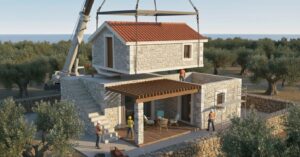
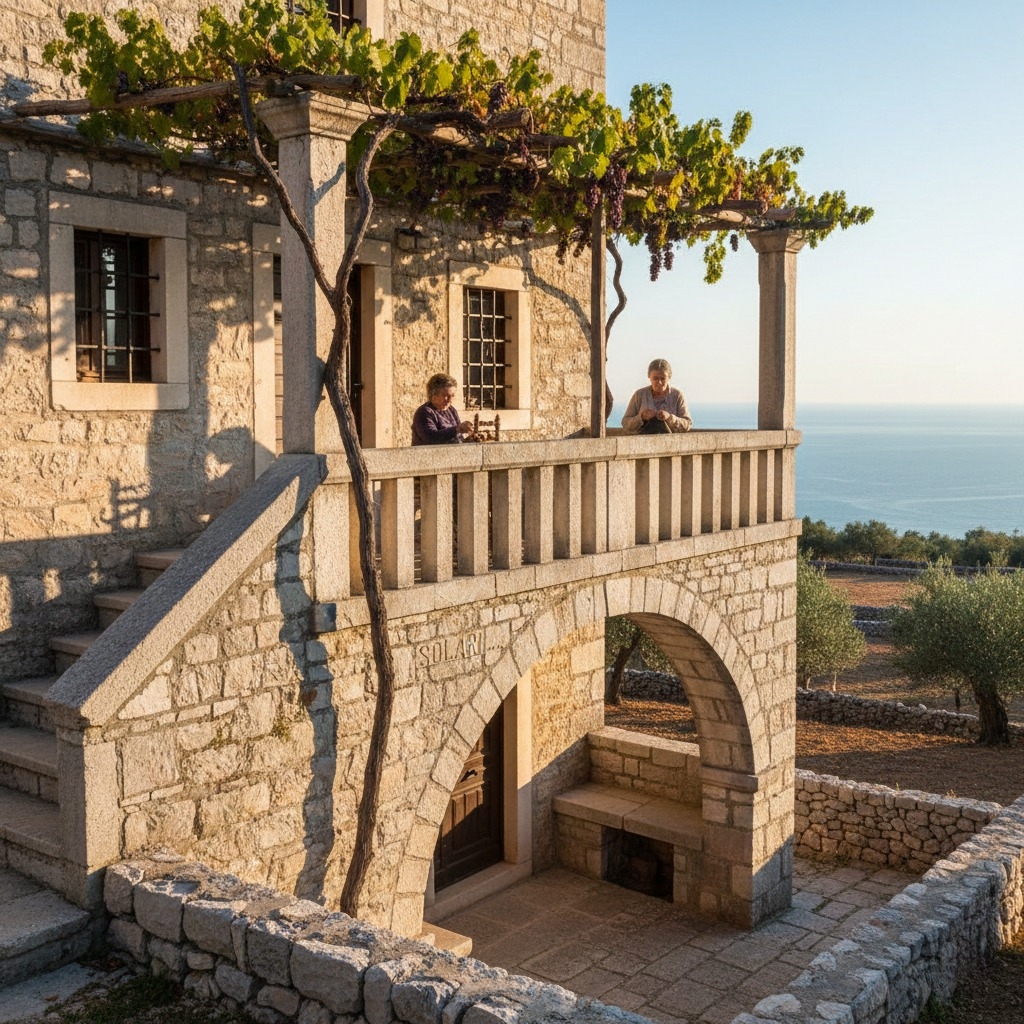
- Solar (balatura): One of the most striking elements is the external stone staircase with a terrace connecting the ground floor and the first floor. It is usually located on the south side, shielding the entrance to the tavern from the sun, while in winter it served as a place for working and resting in the sun.
Materials and construction techniques
The main and ubiquitous material is stone, while the use of wood is kept to a minimum (roof structure, floors, occasional partitions) due to its scarcity in nature.
- Walls: The oldest walls were up to one meter wide, built with two faces and a filling of small stones in the middle. The corners (kantuns) were made of larger, better-finished pieces for strength and beauty.
- Roofs: The structures are simple, gabled, adapted to the heavy covering of stone slabs. The slabs were often coated with lime mortar to prevent leakage, except in the kitchens where smoke escaped through the cracks (joints).
Details that make a home
Each element of the house had its own function, but also aesthetic value:
- Windows and doors: The windows were originally small for security and to save glass, while the front doors were most often wooden with horizontal bars, painted a distinctive green.
- Fireplace (fireplace): A symbol of the family and the center of life. In the northern parts (Bukovica) hearths are at floor level, while towards the south (Konavle) they were raised over time to make the housewife's work easier.
- Chimneys (fumar): Sculptural forms on the roofs that served to vent smoke, from simple raised panels to complex chimneys in the south.
Rural ambience and garden
Life was largely outdoors. Houses were often grouped in courts, forming closed or semi-closed units. The essential parts of the garden were:
Sopes: Stone benches in the shade of vines (odrine) or trees such as koštela and mulberry, where family and neighbors socialized on summer evenings
Cisterns and wells: Key to providing water on arid karst.
Why are these elements important today?
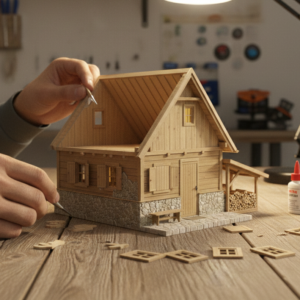
All these elements - from solid cantons and balaturs to sculptural fumares - are not only traces of the past, but fundamental values that we we can build for you in a modern, modular form. Using modern technology and energy-efficient materials, we transform the authentic spirit of the Dalmatian hinterland into a ready-to-live-in home. Our replicas prove that tradition doesn't have to be fragile or demanding to maintain; we build spaces that look as if they have always belonged to the karst on which they stand, while providing you with the ultimate comfort and security of the 21st century.